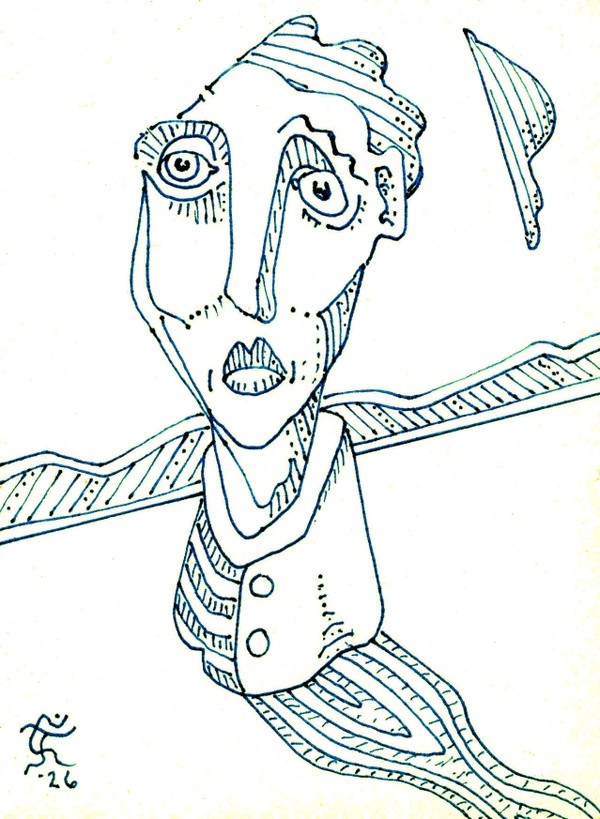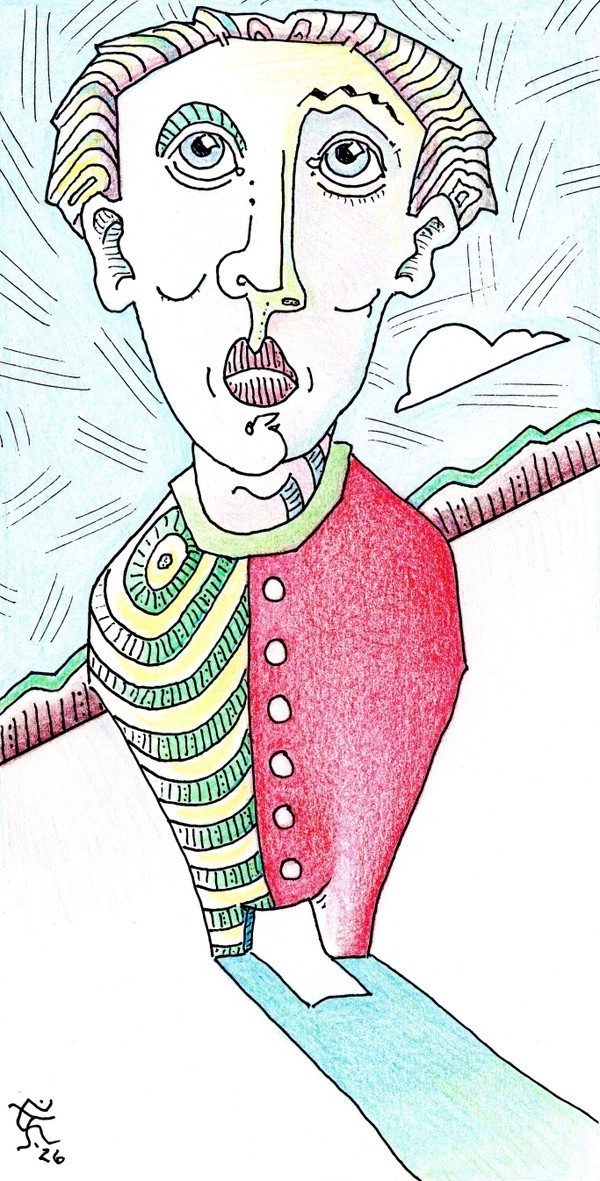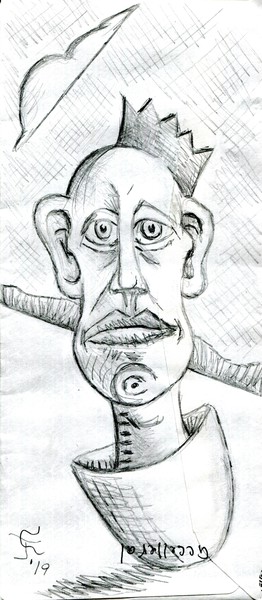









This striking pen-and-ink drawing—Too Weary To Worry—presents a compelling study in linear expression, psychological vulnerability, and graphic distortion, echoing the haunting intensity of early 20th-century Expressionism and Surrealism.
Composition & Formal Structure The work is constructed entirely from crisp blue line work against a raw, off-white paper plane. By eschewing tonal shading or chromatic fill, the artist relies entirely on line weight, density, and mark-making to establish texture, volume, and emotional atmosphere.
Linear Rhythm: The composition is anchored by a elongated figure positioned along the central vertical axis. The head, stretched and asymmetrical, dominates the upper register, while dynamic horizontal forms extend laterally like wing-like appendages or stylized shoulders.
Textural Density: Rather than traditional chiaroscuro, depth is articulated through repetitive patterning. Parallel hatch lines, dotted stippling, and rhythmic linear fills cover the torso, neck, and headgear, creating localized fields of visual friction.
Spatial Dislocation: A small, detached geometric form hovers in the upper-right quadrant. This floating element breaks the symmetry of the composition, creating a sense of psychological weightlessness or severance from external reality.
Stylistic & Art Historical Resonance The drawing evokes several key historical dialogues: German Expressionism & Art Brut: The stylized deformation of the features—wide, asymmetric eyes, exposed teeth within a rigid oval mouth, and exaggerated nasal bridge—recalls the raw, unvarnished psychological portraiture of Paul Klee and Jean Dubuffet.
Cubist Fragmentation: The facial anatomy is fractured and reassembled; the left eye looks straight outward while the right eye appears skewed, creating a multi-perspective tension that destabilizes the viewer’s gaze. Modernist Symbolism: In the lower-left corner, the artist’s monogram is coupled with a date marker ('26), integrated into the composition with the deliberate graphic clarity characteristic of modernist printmakers and illustrators.
Psychological & Conceptual Interpretation
True to its title, Too Weary To Worry, the image communicates a state of profound emotional exhaustion—a threshold where anxiety gives way to a paradoxical, suspended numbness.
The Stared-Out Gaze: The wide, unblinking eyes convey hyper-vigilance turned inward. The dilated pupils and heavily hatched brows suggest an mind that has spent its emotional reserves, rendered passive by relentless stimulation.
Rigidity vs. Buoyancy: The torso is tightly bound within a buttoned, patterned garment, conveying physical constriction. Yet, the horizontal spans and floating upper element suggest a lightness—an detachment from ground-level reality born of sheer fatigue.
The Mouth as Mask: The exposed teeth, framed within an open, static loop, suggest an attempted sigh or frozen utterance—a voice muted by apathy.
Through economical means, the artist transforms simple line drawing into an intimate document of existential fatigue, balancing graphic precision with deep emotional vulnerability.