I'm not an expert or an authority on art but I have visited some major art museums who's collections contain examples of art from some of the oldest to some of the most contemporary art.
The curators who organize what's to be show in the museums I've noticed tend to try to follow a comprehensive historical time line for their exhibits and they choose but a few samples from a huge amassment of art in their collections based upon geography and periods in art history to display. In some cases they borrow examples from other museums or private collections as was the case when I witnessed the setting up of a van Gogh
In the contemporary collections of modern art the few works chosen tend to be samples from artists who have demonstrated an ability to achieve popularity in the art world over time but the work shown may or may not be the most significant or recognizable(Warhol, Pearlstein, Pollock). The same goes for art of the past however in those collections(European, Chinese, Egyptian, Tantric) many works in the museum have been produced anonymous unknown artists.
Some of the most contemporary art I've seen on display tends to have less of a subjective message and more of a conceptual opportunity for people. And it's often not communicating anything intentional. In other words the work in whatever form has a compelling existence sort of like a philosophy book or musical tune does as it manipulates the senses of viewers. On that though even the older subjective art works have that ability too.
One thing I've learned is that it's not important weather anyone likes the art or not to the creator of the art ....who accepts what fate befalls him or her since the art was never created for the purpose of showing it in museums and galleries but rather in some private and personal reason.
Poor art is somewhat harder to define because it it like the story in the bible of Tares and Wheat. both grow up alongside the other and until the time of reaping cannot necessarily be told apart. Wheat has value, Tares are worthless.
It has been shown that even unschooled insane folk have the innate capacity for self expression in a visual art sense: it has been dubbed Art Brut. In the most basic sense any man woman or child can create if given any sort of material or tool and if creatively inspired it will be raised to the level of an object of art but whether that thing created will have a lasting enduring societal effect of being a culturally significant artifact is always uncertain.
Yesterdays fine art may have been replaced by crafty non-artist made handicraft art. Using the word "non artist" may seem a bit snobby or elite but it has some merit to it when one thinks about it. At least I think so. I'm always discarding stuff I love to make because I can see it is not fine art but rather the self amusing indulgence of a habitual doodler, a poet of physical objects, if you will.
"Conceptual" art is a bore to me as simple works which demand little to no thinking but great emotional feeling is what my direction of thought feels at home with. I sort of dislike "intellectual" anything let alone art. Much "academic" art trends lately leave me mentally cold.
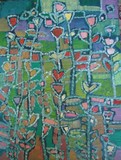
Here's a painting on the plane I'm saying about by Tom Benton of Missouri.
They've actually inspired me. Like when some one steps in a hole, and I avoid it. To the unexperienced eye, they may be fantastic, and draw lots of comments, but it hurts the art form.
Many won't even consider 3d an artform, but I do. I still like "traditional" art, but in the future, 3d works will be part of augment reality. We will see art everywhere we go, we will change our surroundings. I even wrote a book about it. Viva subjectivism!
I suppose it's OK by you because the naive will be your customer. Those colors are the traditional colors of indigenous peoples of South America, Mexico, Peru, Africa and Northern Europe. These colors together do made by American artists are not art but rather exploitation of the primary cultures of the world by suburban consumer capitalists of the western world. It may be art in America but it is not art to the rest of the world!
A. the concept(creative idea)
B. the fabrication(the physical involvement with material)
C. the sharing of it with others including the public
I started a few threads a couple of years ago where I stated the same criteria for determining whether something was or wasn't a work of art. It made a lot of people very uncomfortable, and I got a lot of arguments against the idea that art could or should be defined. Suprisingly to me, the third part of this statement was the most controversial. Many argued that an artist need not show their work. I believe this is the most important aspect as it is the part that gets the viewer involved in the process. Art is concieved in the initial idea, but the presentation is the final delivery in the birthing process of a work of art.
This is why an artist is a part of society and culture....a reflection of it. If in fact a human culture exists at all as the early cave dwelling peoples there is among them expressions of an art and a craft with weapon arrow point carving(craft) or spears and then the picture stories of hunting animals.
I think we as artists need to reflect our culture and environment in art and then create a conversation about it by showing, sharing and telling about it. This contrasts with siting in isolation, making art, and leaving it for others to sort out(don't count on it) at death.
One reason is the high expense of presentation and the other is the know how to show it with finesse.
Like the frame of a picture or the pedestal under a sculpture....and the space it is being shown. The lighting and the atmosphere can change the value of the work.
Also I think the destination of the work of art has an effect upon the artist's career itself. If the work is purchased by a museum or a patron who displays this art in an appealing manner is enhances a career. If it's stored in a warehouse too long or a dusty attic it has been degraded too. If it is improperly cared for in any way it is degraded. Some well known art is rated by the stature and prominence of the owner as well. And if you give your art away to friends and family it may suffer as compared to what happens to the art when it is purchased by someone who has paid a respectable price for it. Although i've seen some nice art sitting lonely and unloved in a discount thrift charity store for $3.00.50 it would be sad to see my work ending up there.
Even when poor or confusing art is shown in a great display it's more valuable than some very good and well done art shown in a degrading display.
However, the evaluation cannot happen without some sort of presentation. The evaluation involves the viewer.
The audience cannot decide whether or not they are experiencing a work of art. Only the artist can define art.
With the presentation the artist communicates, and the viewer responds.
Back to Category
Reply