11 July, 2009

Canvas or masonite/board panels?

Which is better and more durable to use for an oil painting? Stretched canvas or gessoed masonite/board panels? tempered or regular masonite? Are 1400# watercolor boards good for oil?

Reply

9 Comments

Minnie Shuler 07 Aug 2009

Minnie Shuler 08 Aug 2009

Minnie Shuler 08 Aug 2009

CARLEYRAE Weber 13 Sep 2009

I really prefer masonite for painting with oil. I really like the texture you can get while working on a hard surface. Canvas is nice though the "bouncy" surface gives me a little less control of the paint. I work with both canvas and masonite board, and i like both for different reasons.

Justin Diaz 22 Sep 2009

Hi Minnie!

Masonite vs. Canvas!

Let the battle begin. They both have their strengths and weaknesses, I suppose. More durable for right now would have to be Masonite. Tempered masonite is better than regular masonite, it has a stronger surface and is harder in general. I say for right now, because over the scope of all of art history, it only has really been used this century, so for archival purposes, the jury is still out. In 200 years it may crumble and fall to pieces. I seal mine front and back (with whatever acrylic gesso I'm using) to keep out moisture, which may be its biggest enemy. It's also cheaper than canvas (if you stretch it and everything).

But hey, who says you have to choose? If you miss the texture, you can apply your gesso with a stiff bristle brush in a cross-hatch pattern to give you a faux texture, or simply use a thick coat of acrylic gesso as a type of glue and press actual canvass to the surface of the masonite? You get the strength and rigidity of masonite and the full feel of canvas (with all its absorptive qualities) though no spring.

What do you think?

Minnie Shuler 11 Nov 2009

I think you gave a good answer, especially covering the masonite with canvas. I think that is what I will go with. Thanks

Vincent von Frese 08 Dec 2009

I have found that the old fashioned canvas is best because the air gets through the unpainted side and allows complete drying of thin oils. Acrylics also with oil paintings and drawings can be rolled up and stored as well as shipped.

If one requires stability the best paintings that have lasted centuries old are done on tin covered wooden panels. Illustrators I've trained with used painted masonite as I have for quick work and because it's inexpensive. The rule is to seal all edges and the back to prevent moisture from entering and warping the panel. Once they warp they are almost impossible to flatten out again.

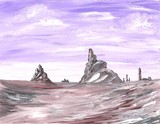
Here is a painting on heavy canvas I purchase from theater supply houses who have huge rolls for their theater mural scenery.

DR LaVoie 16 Dec 2009

I agree with everything that Justin has offered, but with one note of caution: Artists' Magazine warns about the "Tempered (hardboard) Masonite, that contains "oils" used in it's manufacture. These can bleed out into the oils used in your tube paints, unless a minimum of (5) coats of Acrylic Gesso are used. The un-tempered Masonite only requires (2) or at the most (3) coats. And on a personal note, when desiring more texture, I have often painted on the back side that has a texture similar to a Heavyweight Canvas.

K. Henderson 10 Jan 2010

I use both. I would LOVE to paint on masonite only but many of my paintings are large and it just gets too heavy to ship and hang. So for me it's small paintings on board and large paintings on smooth linen or canvas

Reply