30 April, 2009
- J. P.
- 1,257 Views
- 4 Comments

Realistically Drawing Faces
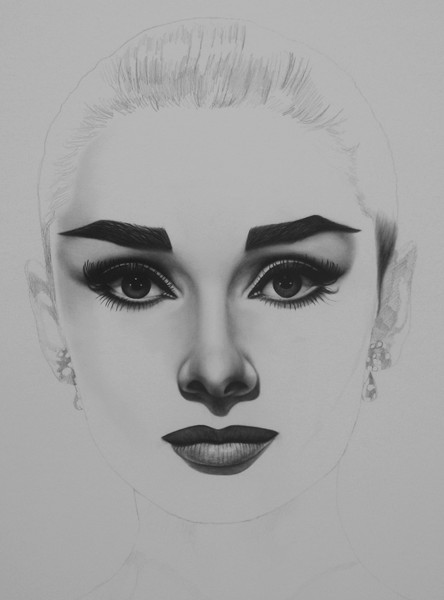
If you are a realistic graphite artist, like myself, then you understand how difficult it is to achieve a faithful, lifelike, large format 30x40 or 40x60 drawing of a human face...particularly - a famous one.
I work on Strathmore 500 series, 4 ply Bristol boards and use Derwent pencils from HB up to #9. Mars erasers are my favorite and FW White Ink is the perfect medium to create the little highlights from the flash inside the eyes.
After studying several images from the subject I wish to draw, I select the one that I feel will create a more dramatic portrait. Mind you, I do not want to re-create a photograh, but a work of art realistically enough to be considered lifelike.
I start by working every detail very lightly using an HB pencil, I keep my points very sharp at all times with an electric Xacto sharpener. Never do I "throw lines" around, I feel that the most precised and controled sketch I make, the better the end results and to be honest I try very hard not to make mistakes since I do not like to erase other than to keep my work clean around the subject if needed and to avoid smudges, I keep regular, white paper like for everyday printing between my hand and the board, always. Never place your fingers or palms onto the surface of your board, hands, regardless of how clean you keep them, have natural oils that will transfered to the board and when shading over will show as darker spots that are very tough and tricky to clean up, sometimes depending of what area - impossible, and this can ruin your work.
After the sketch is done, I start with the eyes and eyebrows first, then the nose follows and lastly the mouth. If I'm satisfied, then I move to the skin, hair and the rest of the piece. I turn my work around clockwise to gain better access to the features I need to work on.
To be honest, I never really know if a portrait will be finished successfully until is time to sign it. Anything can happen while I'm working it that will make me not want to continue or trash it, but this is me. You of course do what you feel works best for you.
I try not draw if tired nor I get too involved if I'm not having a good time while drawing and if I feel that progress is not happening as expected, I put the work away and/or start something else. Eventually, I return to it and most times it turns out ok.
Best drawing advice I can give you regarding faces is - don't take creative freedom and ad or take away major key elements from the original. Keep your work as faithful as possible and use a mirror to view your work after each application, the view of your work from a mirror's perspective will tell you if there's a problem you should address right away better than by just looking at it alone.
Also take pictures of every stage of your work, it builds a stronger portfolio and shows other people the process of how your work becomes a finished portrait.
Once I signed a piece, I spray very lightly with a matt fixative for protection. Always shake your can for about a minute or two. Never spray directly from the start, always point away from your work, press the valve and then maintining at least 12 inches between the can and the artwork cover the entire surface from left to right without stopping on your work. Spurts of fixative can happen and this is something you really do not want.
I hope I was able to help you in some small way with this posting and if you have any questions, by all means feel free to ask me, I will be delighted to hear from you and offer my 2 cents worth.
Click on my JP link to view other images in progress. Thank you.